
Structured Notes, Unpacked

If you've come across the term "structured note" and weren't quite sure what it meant, you're not alone. It's one of those phrases that sounds more complicated than it needs to be. This guide breaks it down simply, using definitions from the U.S. Securities and Exchange Commission (SEC) and the Financial Industry Regulatory Authority (FINRA), two of the most authoritative, neutral sources on the topic.
The Simple Definition
According to the SEC's Office of Investor Education and Advocacy, a structured note is a security issued by a financial institution "whose returns are based on, among other things, equity indexes, a single equity security, a basket of equity securities, interest rates, commodities, and/or foreign currencies." In other words, your return is linked to the performance of something else, a reference asset or index, rather than being a fixed, predetermined payment.
The Two Parts Inside Every Structured Note
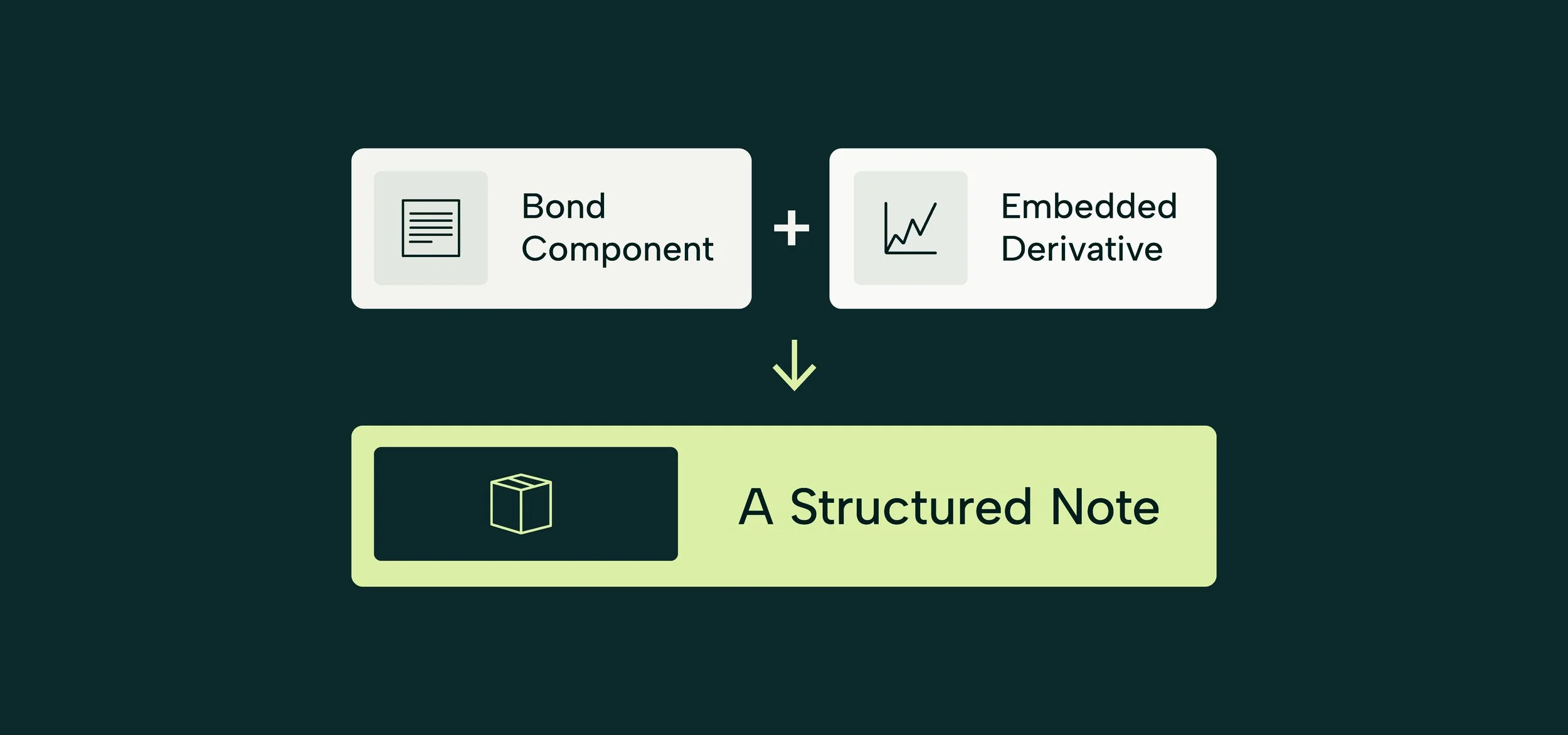
The SEC describes structured notes as having two components:
A bond component. This is the foundation, generally responsible for repaying some or all of the amount invested at maturity.
An embedded derivative. This is what links the note's return to the reference asset's performance.
Think of it as a hybrid: part debt instrument, part derivative contract, packaged together into a single security with a fixed maturity date.

The Building Blocks You'll See Across Structured Notes
Whatever the specific product, most structured notes share a few common elements:
An issuer. Typically a bank or financial institution. Because a structured note is an unsecured debt obligation, your return depends not just on the reference asset's performance, but on the issuer's ability to pay.
An underlying reference asset or index. This is the "something else" the return is linked to.
A term, or maturity date. Structured notes are built to run for a defined period.
A payoff structure. This determines exactly how the reference asset's performance translates into your return, and it can vary significantly from note to note.
A credit risk profile. Because you're relying on the issuer's promise to pay, not a pool of assets you own directly.

What to Understand Before Exploring Further
FINRA's guidance on complex products is direct about this: structured notes require investors to understand not just what they're invested in, but how the payoff actually works. A few things worth knowing generally:
They're not risk-free, even when marketed with terms like "protection" or "guarantee." A joint SEC and FINRA investor alert on principal-protected structured notes put it plainly: these products "are not risk-free."
Liquidity can be limited. Structured notes aren't always easy to sell before maturity, and secondary markets, where they exist, may not reflect the same value as the original investment.
Complexity cuts both ways. The same structure that can offer a defined outcome can also make it harder to evaluate what you're actually getting, and at what cost.
This means structured notes reward the same thing every investment decision rewards: understanding what you're actually holding before you hold it.
Why This Matters Now
Structured notes represent a meaningful and growing part of the investment landscape, with real, published industry data showing significant year-over-year growth in issuance.
As more investors gain access to products that were once reserved for institutional or high-net-worth portfolios, understanding the basic mechanics matters more, not less.
This is the first in a series of plain-language guides covering structured notes and exchange-traded products. Next, we'll look at exchange-traded products (ETPs), a different but related category, before comparing how the two actually stack up against each other.
Sources cited: U.S. Securities and Exchange Commission, Office of Investor Education and Advocacy, "Investor Bulletin: Structured Notes" (January 12, 2015); FINRA & SEC joint alert, "Structured Notes with Principal Protection: Note the Terms of Your Investment" (June 2, 2011); FINRA Regulatory Notice 12-03, "Complex Products" (2012).
This article is for general educational purposes only and does not constitute investment advice or a recommendation regarding any specific security or issuer.
