
The Future of Innovation: How AI Reshapes Long-Term Investing
The world stands at a fascinating moment in technological history. AI is transforming industries, reshaping societies, and fueling investor excitement — but understanding its place in a broader cycle of innovation is critical. Drawing on the work of economist Carlota Pérez, we can frame today’s AI surge within a familiar, long-term paradigm. That perspective matters deeply for strategic investors looking beyond the next quarterly return.

The Pattern Behind Major Tech Revolutions
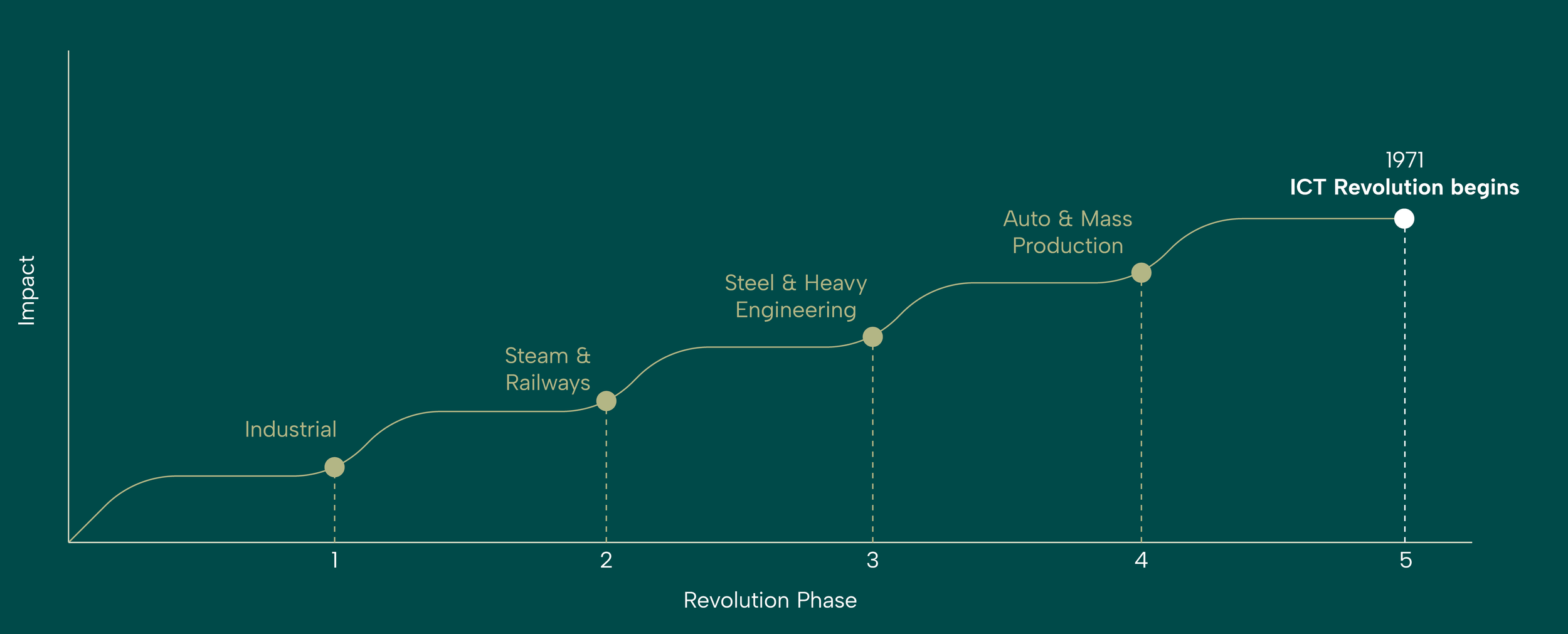
Cycle of Technological Revolutions
Across 250 years of economic history, each technological revolution followed recognizable stages: early experimentation, rapid infrastructure build-out, financial speculation, consolidation, and finally broad societal deployment. Research from economists like Carlota Pérez, Erik Brynjolfsson, Daniel Susskind, and Daron Acemoglu supports a consistent pattern:
1. Each revolution creates a new “general-purpose technology” (GPT).
Throughout history, breakthroughs like steam power, electricity, and microprocessors became embedded across every sector and drove long multi-decade productivity cycles. AI now shows the same characteristics, expanding beyond a single industry into the core of economic infrastructure. Studies from the IMF and OECD suggest that AI could raise global productivity by 0.5 to 1.5 percent annually as adoption accelerates.
2. The turning point is shaped by capital allocation and policy.
Past transitions gained momentum only when infrastructure investment, regulatory clarity, and workforce realignment converged to support the next stage of growth. AI is moving along this same path as nations invest heavily in compute capacity, standardized testing frameworks, and responsible governance models. Institutions such as the World Bank and OECD increasingly describe AI infrastructure as comparable in importance to electrification.
3. Deployment phases drive the strongest and most stable returns.
Once a technology matures, productivity rises across industries such as manufacturing, healthcare, finance, transportation, and logistics. This is the phase when speculative excitement gives way to operational efficiency and real economic value creation. AI now sits close to this transition point, widely adopted but not yet fully integrated into global productivity systems.
AI sits at the threshold of this shift — not fully deployed, yet far past early experimentation.
4. The next decade will likely revolve around AI-enabled economic restructuring.
Enterprise adoption is accelerating at an S-curve pace, with McKinsey projecting AI-enabled automation to grow at a 25 to 35 percent CAGR. Governments across major economies are aligning policy around compute access, talent, and responsible deployment standards. Capital is already rotating toward companies that embed AI into operations rather than those positioned solely as AI builders.
5. AI is set to become a foundational layer for the next era of value creation.
Rather than marking a new standalone revolution, AI is acting as the integration engine that completes and elevates the Information Age. It enables software-defined industries, modernizes supply chains, and unlocks new cycles of labor productivity. This positions AI as a central driver of economic expansion for the next two to three decades.
Where AI Fits In: Not a New Revolution, but a Milestone

According to Pérez, AI is not the start of a new, sixth revolution. Instead, she places AI squarely within the ongoing Information Age (ICT revolution), seeing it as a pivotal technology in its deployment phase. (LinkedIn)
That distinction matters for investors. The installation phase, led by speculative financial capital, is often volatile and marked by bubbles. But in the deployment phase, production capital takes over, and previously speculative technologies mature into reliable value drivers. (Univrs)
Why This Moment Is Significant
Pérez suggests we may still be in a turning point, a critical inflection where the speculative fervor of earlier decades gives way to more sustainable, long-term integration. (Carlota Perez)
This juncture demands institutional innovation — new policies, governance, and capital approaches — if society is to harness AI’s full potential. Public infrastructure, regulation, and long-horizon investment must evolve to shape a “golden age” rather than repeat past cycles of boom and bust. (Carlota Perez)
Implications for High-Net-Worth Investors
For HNW investors, this framework offers a powerful lens:

Volatility alert: Turning points can be turbulent. Expect periods of instability, market correction, and reevaluation — historically, these have preceded deeper integration.

Strategic allocation opportunity: As production capital gains influence, there may be unique windows to invest in technologies and industries that are gaining real-world traction.

Policy tailwinds: The shape and timing of a future "golden age" will depend on how governments and institutions adapt. Investors who align with policy-forward, mission-driven companies may benefit disproportionately.

Long-term vision: This isn’t about fast gains. Positioning for the deployment era of ICT means playing the long game — backing foundational companies, infrastructure, and public-private partnerships.
MYJ Insight
We believe AI’s current momentum is not just speculative hype but a gateway into a mature phase of the Information Age. Institutional capital, guided by smart capital allocation and regulatory frameworks, stands to define the next decade. Investors who lean into that transition now can capture the real structural value — not just short-term upside.
Contact MYJ Capital for tailored investment strategies that harness insights from deep technological cycles. Together, we can align your capital with the long-term momentum of innovation — for both profit and purpose.
Connect with us at
