
The ETP Universe: One Wrapper, Three Distinct Structures
Global ETF assets closed 2025 at a record US$19.85 trillion, up from US$14.85 trillion just a year earlier, according to ETFGI. December 2025 marked the 79th consecutive month of net inflows into ETFs, a run stretching back more than six years. That scale and consistency make exchange-traded products one of the defining structures of modern markets, and yet the category itself remains widely misunderstood. Most investors recognize the ETF. Far fewer could explain how it relates to an ETN or an ETC, or why that distinction matters.
This guide covers all three, using definitions from FINRA and major global exchanges.
The Simple Definition
FINRA's investor education page frames it precisely: "there's no single definition of an exchange-traded product (ETP)." In general, an ETP is a security listed on an exchange that provides exposure to a benchmark, an index, or an actively managed strategy. It trades intraday, at a live price, the same way a stock does, in contrast to a traditional mutual fund, which prices once a day.
That single sentence covers a far wider family than most investors realize, and as of late 2025, that family spans more than 15,600 products listed across 83 exchanges in 65 countries, per ETFGI.
One Family, Three Structures
Here's the distinction that actually matters.
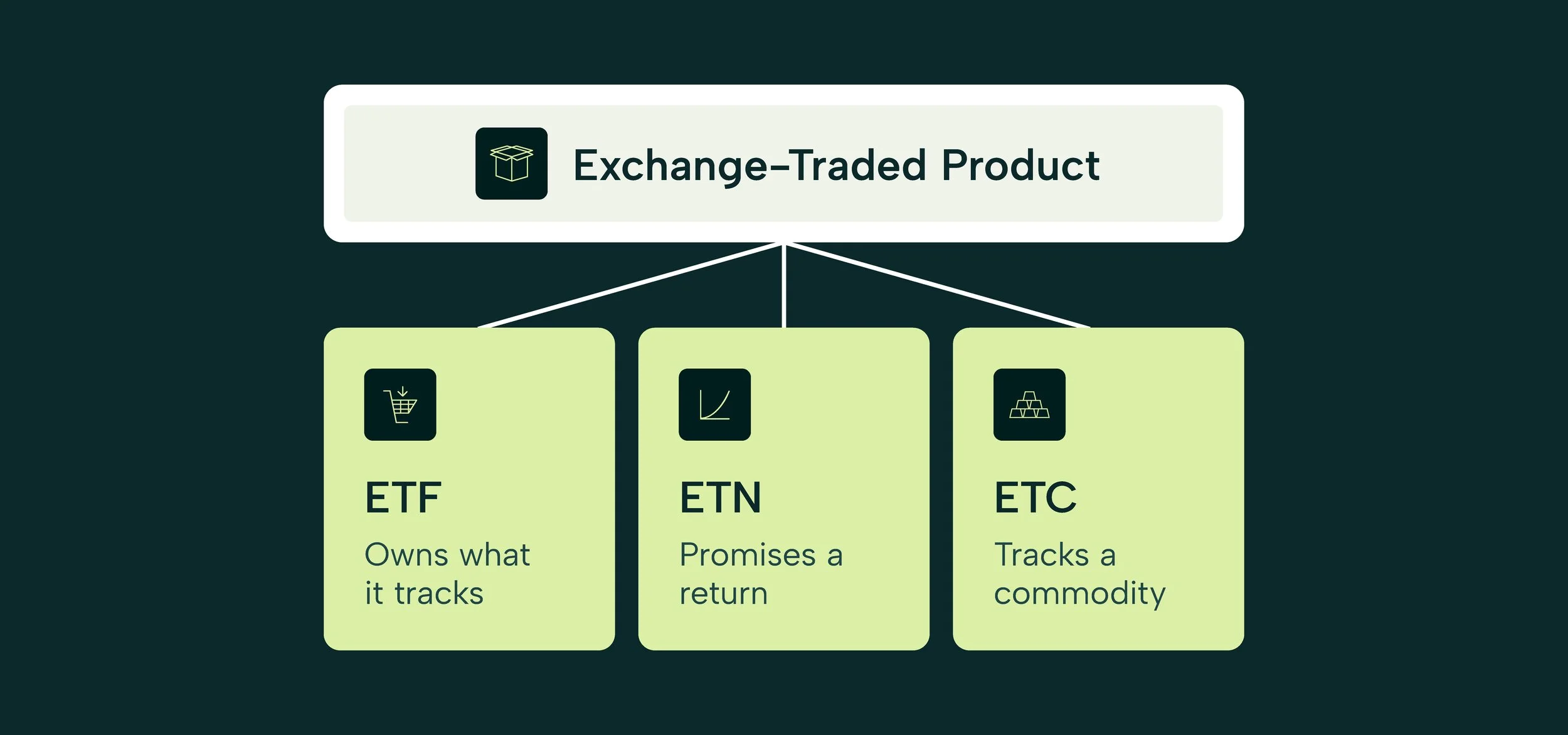
ETFs (Exchange-Traded Funds) hold the assets they track. When you buy an ETF, you own a share of a pooled fund that owns real underlying securities, stocks, bonds, or other assets. Most are registered under US investment company law and meet defined diversification requirements. The ETF is the most common and most recognized member of the ETP family for exactly this reason: ownership is direct.
ETNs (Exchange-Traded Notes) carry the return in a different way. An ETN is a debt obligation issued by a financial institution, and its value comes from the issuer's promise to pay, calculated against a benchmark or index. FINRA describes it as representing "a promise to pay a return at maturity reflecting the performance of some benchmark or index." The distinction that follows matters directly: an ETN's ultimate value depends on the issuing institution's ability to pay, since its worth rests entirely on that promise rather than on a pool of owned assets.
ETCs (Exchange-Traded Commodities), common in European markets, work on a similar principle, tracking a commodity or basket of commodities through a debt structure rather than direct ownership. The London Stock Exchange describes ETCs and ETNs as securities "structured as notes which track the performance of an underlying index or a single commodity." Deutsche Börse draws the line clearly: "Unlike ETFs, the funds invested in ETCs and ETNs are not part of the issuer's special assets, but are debt securities."
The single sentence worth remembering: an ETF owns what it tracks. An ETN or ETC promises a return linked to it.

How ETPs Actually Trade
Part of what makes the category work is what FINRA calls "two layers of liquidity." The first operates behind the scenes, where authorized participants create or redeem large blocks of shares directly with the fund or issuer, keeping the traded price aligned with the underlying value. The second layer is the one investors interact with directly: ordinary buying and selling on an exchange throughout the day, at a price that moves in real time.
This structure sets ETPs apart from traditional mutual funds, which transact once daily at a single price. It's also why FINRA notes that ETPs are regulated "under the Securities Act of 1933 and Securities Exchange Act of 1934," while pointing out that "different ETPs may offer different levels of investor protection" depending on the specific structure involved.
What Sets Each Structure Apart
A few distinctions carry through the entire category, regardless of which specific ETP an investor eventually explores:
Market exposure moves with the underlying benchmark, for every structure in the family.
Credit exposure applies specifically to ETNs and similarly structured products, since their value rests on the issuer's ability to pay.
Tracking performance can vary slightly from the benchmark itself, a normal feature of how these products are built.
Trading conditions differ by product: bid-ask spreads and trading volume shape how efficiently any given ETP can be bought or sold.
Why the Category Keeps Growing
The scale here reflects a genuine structural shift in how capital moves through markets, both retail and institutional. A US$19.85 trillion asset base, a 79-month inflow streak, and 15,600-plus listed products across 65 countries describe an ecosystem still very much in expansion.
This is the second guide in a series exploring exchange-traded products and structured notes as distinct categories. Having introduced each on its own terms, the next piece places both side by side, comparing how they work and what each is generally suited for.
Sources cited: FINRA, "Exchange-Traded Funds and Products"; London Stock Exchange, ETP guide; Deutsche B\u00f6rse, "About ETF, ETN, ETC and ETP"; ETFGI, global ETF industry press release (January 2026).
This article is for general educational purposes only and does not constitute investment advice or a recommendation regarding any specific security or issuer.
